

A business can adopt the newest AI tool and still repeat an old mistake: producing more activity without making the customer’s decision easier. It can also run a simple website that works well because the information is clear and the process is reliable.
The useful question is not whether your marketing looks new. It is whether an old habit is creating confusion, weak evidence or wasted work. These are the practices worth reviewing first.
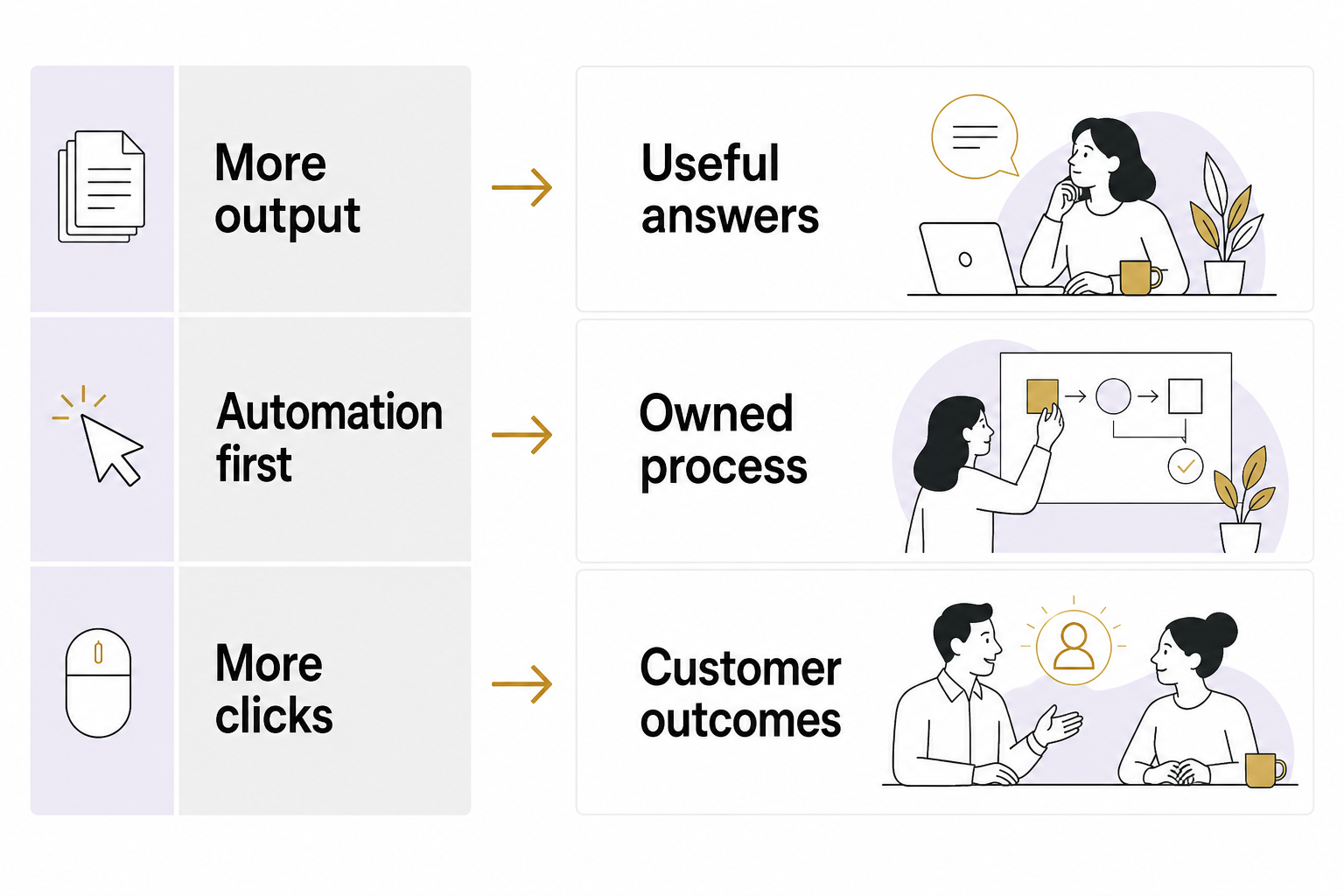
Publishing more because production is easier
AI makes it easier to create drafts, variations and summaries. That does not mean every draft deserves a page. A site full of similar explanations can leave readers searching through repetition for a specific answer.
Google’s spam policies address keyword stuffing and scaled content produced to manipulate rankings rather than help users. The problem is the purpose and quality of the content, not merely which tool helped write it. Google Search: Spam policies
Replace the volume target with a question target. Identify what a reader needs, what evidence you can provide and how the piece differs from existing pages. Update or combine overlapping material when that creates a clearer answer.
Treating keywords as a repetition quota
A keyword is a clue to a person’s need. It is not an instruction to repeat the same phrase in every heading. If a sentence reads awkwardly, a supposed density target is not a good reason to keep it.
Use clear terminology, explain related questions and make headings useful for scanning. Review the page with the keyword count hidden. Can someone understand the answer and the next step? That is a better editing test than chasing a percentage.
Confusing dated information with a dated design
A visually modern page can still contain the wrong hours, obsolete instructions or a service the business stopped offering. Conversely, a stable page does not need constant rewriting when its answer remains correct.
Maintain content according to change risk. Platform tutorials, product details and policy explanations need different review schedules. Record which source supports important claims and when it was checked. Change the update date when substantive review or correction warrants it, not to create the appearance of freshness.
Automating before defining the process
A follow-up sequence cannot repair an unclear handoff. An AI assistant cannot reliably decide whether a lead qualifies if the business has never defined qualification. A tag cannot measure a completed sale when it fires on every button click.
Write the rule, test the manual path and then automate the repeatable part. Keep approvals for actions that publish, spend, disclose data or make commitments. AI risk management is an ongoing process of evaluating the system and its use, not a single tool-selection decision. NIST: AI Risk Management Framework
Keep a record of what the automation can read and change. Someone should know how to stop it and recover from a wrong action before it handles a large batch.
Calling every dashboard increase a business win
Visits, impressions, opens and form events describe different activities. None automatically equals a qualified lead or a customer. A new integration can even increase a metric by counting the same activity twice.
Connect marketing reports to outcomes and document the limits. Use consistent date ranges and definitions. If customer revenue is not available, say so. Do not ask AI to invent the missing bridge between traffic and sales.
When an assistant explains a trend, require separate sections for observations, possible causes and evidence needed. A well-written explanation is not proof of causation.
Adding personalization where clarity would do
Not every page needs to change for every visitor. A clear service page, a readable price explanation or a useful comparison may serve many people well. Personalization introduces more variants to maintain and more opportunities for inconsistent information.
Use it when you can explain the benefit and support the data use. Do not infer sensitive characteristics or pretend to know a visitor’s needs from a weak signal. Give people an understandable path even when tracking is unavailable or declined.
A hypothetical example
A retailer plans to replace its entire site with an AI-generated experience. An audit finds the main problems are outdated delivery information, broken product filters and duplicated purchase events. Repairing those issues first makes the current site more usable and the reports more trustworthy. A redesign can then be judged on its actual value.
Prioritize the changes customers will notice
Start with broken journeys, inaccurate facts and exposed data. Next, improve unclear content and difficult interactions. Test the important pages on a phone, with a keyboard and after declining optional tracking. Check the completed task rather than stopping at the homepage.
Choose a short list of changes, record the evidence and verify the result. Modern marketing is a maintenance discipline as much as a creative one.
If you need help deciding what to fix first, bring your website and marketing questions to an Eastmoor Digital discovery call.
Sources & further reading
Primary references checked for this refresh. Availability and platform behavior may change.
- Google Search: Spam policiesChecked 2026-08-31
- NIST: AI Risk Management FrameworkChecked 2026-08-31