

A referral partner says it helped win a customer. Your paid search report also claims that customer. The customer says a colleague mentioned you months ago. Everyone may be describing a real part of the journey.
Measuring channel marketing means deciding how you will evaluate partners such as affiliates, resellers and referral organizations. It requires more than counting visits from partner links. You need a shared definition of credit, records that survive the sales process and a scorecard that reflects the work each partner does.
Separate partner channels from media channels
Organic search, email and paid social are media or acquisition channels. A distributor, reseller or referral organization is a business partner. A partner might use several media channels while promoting your business.
Keep separate fields for the partner and the campaign source. Otherwise, a referral from a partner’s newsletter may disappear into a generic email category. That makes it difficult to judge the relationship or support the partner properly.
Start with a small partner register: a stable ID, organization name, relationship owner, agreement reference, lead submission method and review cadence. Do not let an assistant invent commission terms or change the agreement to make reporting easier.
Agree on what earns credit
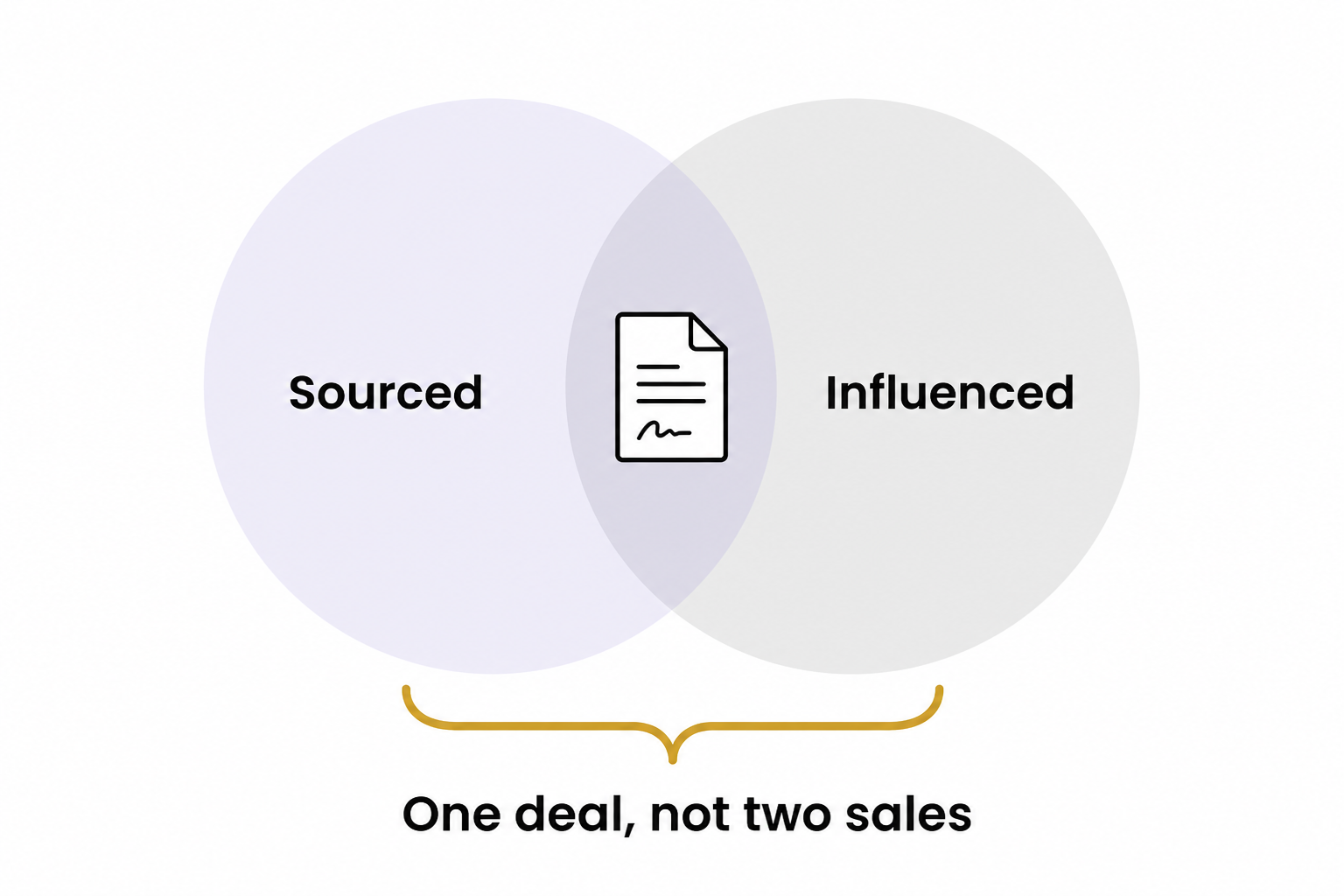
A sourced opportunity is one the partner originated under your agreed definition. An influenced opportunity is one where the partner contributed, but did not necessarily originate it. Report both if useful, but do not add them together as though they were separate sales.
Define how duplicates, existing accounts and competing claims are handled. Decide what evidence is required, who resolves exceptions and when a claim becomes final. Marketing attribution and contractual compensation are related decisions, but one should not silently replace the other.
Keep a change history when credit is edited. A report that changes every time a deal owner updates a field needs an explanation, especially when the report is used for partner payments.
Capture a partner ID at the handoff
Use tagged partner links for campaign measurement, plus a partner field in the lead or deal record. Google supports campaign parameters for describing traffic sources; a tagged visit still does not establish the full business relationship. Google Analytics 4: URL builders
Provide partners with a documented naming pattern and approved destination pages. Do not include a person’s email address or sensitive details in the URL. Test whether the partner reference survives the form and reaches the correct CRM record.
For offline referrals, provide an approved submission process. Record the prospect’s permission and necessary context through the appropriate business workflow. A spreadsheet sent around indefinitely is a poor substitute for an owned handoff.
Build a scorecard around progression
- Accepted leads: real inquiries meeting the program’s qualification rules.
- Opportunity rate: accepted leads that become meaningful sales opportunities.
- Won customers: outcomes from a lead group that has had time to mature.
- Time to progress: where leads wait and why.
- Contribution: revenue less the costs you deliberately include, with the calculation labeled.
- Partner readiness: access to current materials, understanding of the offer and unresolved support needs.
Report costs consistently. A measure that subtracts only commission is different from one that also subtracts delivery costs, discounts and support. Do not call either net profit unless the definition and accounts support that label.
A hypothetical example
Partner A submits many inquiries, but most ask for a service you do not provide. Partner B submits fewer inquiries, yet those buyers usually match the offer. The useful response is not automatically to favor the largest lead count. Review qualification, customer outcomes and the time each relationship consumes.
For Partner A, an updated referral guide might solve the mismatch. For Partner B, the constraint might be limited awareness of your full service area. Those are different actions, even when both partners appear in the same chart.
Use AI for evidence review
CRM assistants can help summarize records and prepare review discussions; HubSpot documents these uses for Breeze, subject to account settings and access. HubSpot: Use Breeze Assistant
Ask an approved assistant to group anonymous lost-opportunity reasons by partner, highlight missing handoff information and return the source records for each pattern. Compare its summary against a sample of actual records before drawing conclusions.
Do not let AI settle disputed credit or infer that a partner caused every associated sale. It may confuse a copied company name with a referral relationship, or mistake an updated record for a new opportunity. Keep credit rules deterministic and exceptions reviewable.
Make the review useful to the partner
Discuss one friction point, one needed resource and one next step. Share only data the partner is entitled to receive. Record the action and revisit it after the relevant sales cycle, rather than expecting every relationship to show movement in a week.
If the handoffs and reports do not agree, an Eastmoor Digital discovery call can help map the measurement process before you expand the program.
Sources & further reading
Primary references checked for this refresh. Availability and platform behavior may change.
- Google Analytics 4: URL buildersChecked 2026-08-31
- HubSpot: Use Breeze AssistantChecked 2026-08-31