

Two people can share an age, income range and neighborhood yet buy for completely different reasons. One needs an urgent repair. The other is researching a future upgrade. A demographic profile alone will not tell you what either person needs to hear.
Your target audience is the group your offer is suited to help. Finding it means understanding the problem, the buying situation and the limits of your service. AI can organize research, but it cannot replace evidence that real people want what you provide.
Start with the problem and the moment of need
Describe what happens before someone looks for your product or service. What changed? What task are they trying to complete? What risk or inconvenience are they trying to avoid?
Then identify the decision. A buyer comparing long-term options needs different information from someone trying to solve an immediate problem. A person researching for a manager may need evidence they can share, while the decision-maker may need a clearer explanation of tradeoffs.
Write the audience in practical terms: “Businesses opening a second location that need consistent website information,” for example. This is usually more useful than a fictional name, favorite coffee and unsupported personality description.
Collect evidence from several places
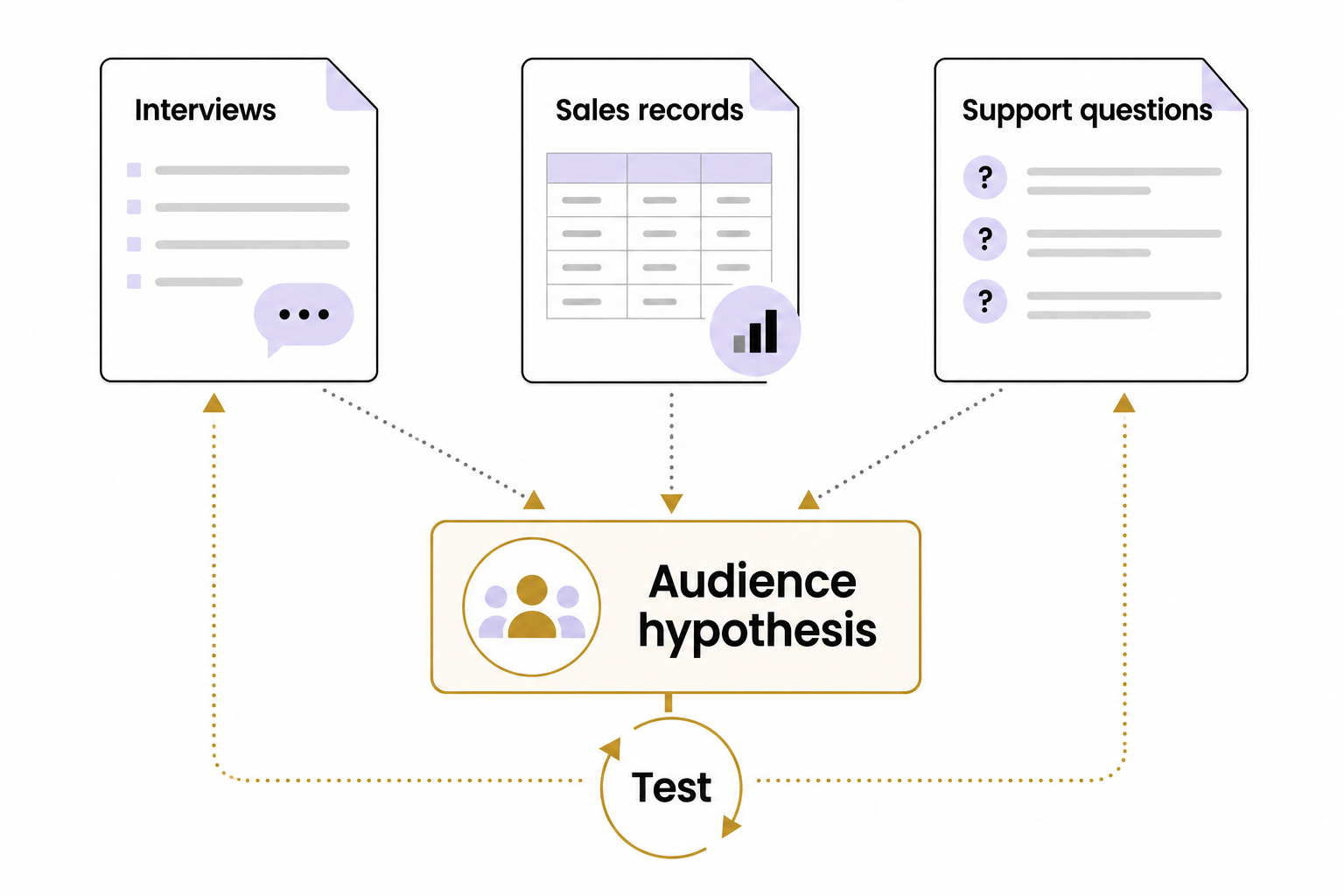
Review recent qualified inquiries, won and lost opportunities, support questions and customer interviews. Use records you are authorized to access, and minimize private information when organizing them for research.
Look at search queries and page behavior as additional clues. They can show what people asked or visited, but they do not reveal every motive. Public comments can suggest questions worth investigating without representing your entire market.
Keep a simple evidence register with the observation, source, date and confidence. Label a customer’s statement separately from your interpretation. A single memorable conversation may be valuable, but it is not automatically a market-wide pattern.
Ask questions that reveal a real decision
- What happened that made you start looking?
- What had you already tried?
- Which alternatives did you consider?
- What information was difficult to find?
- What almost stopped you from moving forward?
- What made an option unsuitable?
Ask about actual events rather than inviting people to agree with your idea. “Would you like a faster service?” usually produces less useful evidence than asking what happened the last time they arranged the service.
Include people who did not buy when you can appropriately reach them. Studying only happy customers can hide the reasons suitable prospects left.
Segment by meaningful differences
Create groups when the difference changes the offer, message, channel or buying process. Urgency, use case, service area and approval requirements may matter more than broad demographic categories.
Use age, gender or other personal characteristics only where relevant, appropriate and supported. Do not infer sensitive traits from names, photographs or weak behavioral clues. Avoid treating a group label as a prediction about an individual’s needs.
Also define negative fit. Which requests can your business not fulfill? What service areas, project types or timing constraints should the marketing explain clearly? Excluding an unsuitable request from your offer is different from making unsupported assumptions about the person.
Use AI to organize, then challenge the pattern
Give an approved assistant anonymized notes with source IDs. Ask it to group recurring problems, show the records behind each group and identify contradictions. Require a separate list of missing information.
Then ask for alternative explanations. A cluster of price concerns might reflect an unclear offer, poor fit or genuine affordability constraints. The model should not decide which explanation is true without further evidence.
NIST’s AI risk framework emphasizes evaluating trustworthiness across AI use. In audience research, that means checking output against records and considering where the process could misrepresent people. NIST: AI Risk Management Framework
Do not use synthetic customers as substitutes for actual interviews. An assistant role-playing a buyer can help rehearse questions or identify gaps in a brief. Its answers are generated hypotheses, not research findings, quotes or proof of demand.
A hypothetical example
A software service initially targets “small business owners.” Research reveals a more actionable group: owners replacing a shared spreadsheet after missed follow-ups. Their key questions concern migration, ownership and learning time. The message can now explain those issues rather than making broad promises about productivity.
Test the audience definition in the market
Create one clear message and destination for the proposed group. Use a limited, appropriate distribution test. Track whether inquiries fit the problem and whether the page answers the questions buyers actually ask.
Do not judge solely by clicks. A message can attract attention from people you cannot serve. Review qualified outcomes and the reasons people decline. Record what would cause you to revise the audience definition before the test begins.
Your target audience should become clearer as evidence accumulates. If you need help connecting research to your offer and content, bring the records to an Eastmoor Digital discovery call.
Sources & further reading
Primary references checked for this refresh. Availability and platform behavior may change.
- NIST: AI Risk Management FrameworkChecked 2026-08-31