

A business publishes a helpful post, then adds a long block of hashtags because someone said that is how people discover it. Half the tags are broad, several are unrelated and none explains why the post matters.
Hashtags for business are most useful when they help a reader understand or navigate a topic. They are not a substitute for clear content. As social discovery becomes more automated, the sensible approach is to give people useful context rather than hunt for a magic list.
Understand what a hashtag actually does
A hashtag joins a word or phrase to the # symbol so it can function as a topic label. Platforms handle discovery differently. Do not assume a tag carries the same visibility, reporting or community behavior everywhere.
X describes hashtags as a way to categorize posts and find related topics. Its guidance recommends no more than two per post as a best practice. That recommendation is not a universal rule for every network.
Check the current composer and official platform guidance before relying on old limits or count formulas. The useful question is whether each tag adds relevant meaning.
Start with the post, then consider the label
Write the answer, demonstration or announcement first. Include natural language that explains the subject, location and intended audience where relevant. A reader should understand the post even if the hashtags disappear.
For a hypothetical woodworking class, the caption should state what participants will learn and where the session takes place. A tag can group the event or topic, but it should not carry essential information that belongs in the sentence itself.
Avoid attaching broad trending tags to an unrelated offer. That can confuse the conversation and make the business appear inattentive to context.
Research the actual conversation
Search a proposed tag on the platform before publishing. Read recent posts and check how people use it. Does it describe the intended subject? Is it dominated by unrelated promotions? Has its meaning changed because of a news event?
Inspect spelling and possible alternate readings. Capitalizing each word in a multiword tag can improve readability. Keep the label short enough to recognize and reproduce without turning it into a sentence.
Do not assume that a large reported post count means a useful audience. Popularity, relevance and buyer intent are different questions.
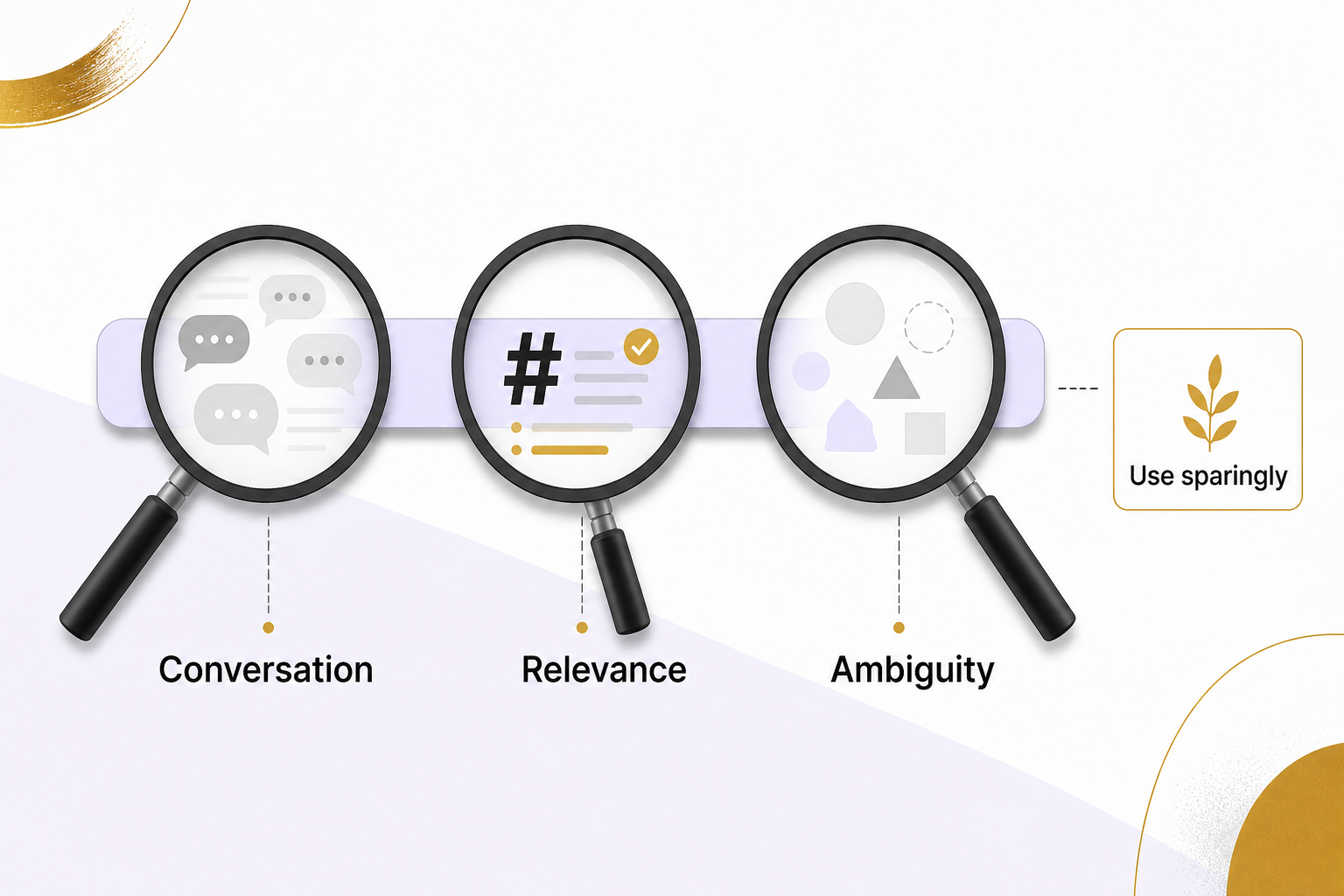
Use AI to suggest candidates, not certify them
Give an assistant the finished post, audience and platform. Ask for a small set of possible labels with an explanation of why each fits. Then verify every candidate in the actual platform search.
Grok can use public X posts and web search, which may help investigate a conversation. Its summary still needs checking against the underlying posts. A model can misunderstand irony, combine unrelated topics or treat old activity as current.
Reject invented activity counts and unsupported statements that a tag will increase reach. Do not upload private customer data to make hashtag suggestions more personalized; the public content should normally provide enough context.
Understand discovery beyond hashtags
In June 2026, Meta announced Facebook AI Mode using public conversations to answer questions. This illustrates how discovery can draw on more than a manually added tag.
It does not establish a ranking formula or a way to guarantee inclusion in AI answers. Focus on accurate descriptions, useful explanations and clear connections to your business. Repeating a phrase or tag across many low-value posts does not create expertise.
Keep profiles and destination pages current. A discovery feature sending someone to stale information creates a poor experience regardless of how the person found you.
Use branded tags when people have a reason to participate
A branded or event tag can help group a campaign, workshop or shared activity. Explain what people can contribute and make the label visible in relevant materials. Search it first to avoid confusion with an existing use.
Do not treat use of a tag as automatic permission to reuse a person’s photo, add them to a mailing list or send automated replies. Ask for the permissions needed for the action you want to take.
The woodworking class might invite attendees to share an optional finished-project photo using an event label. The business should still request permission before placing that photo in advertising.
Measure the content, not an imagined hashtag effect
Review relevant conversations, profile actions, visits and inquiries. Compare similar content over time, recording what changed. A better-performing post may differ in subject, timing or visual quality as well as tags.
Where the platform does not provide reliable tag-level attribution, say so. Avoid assigning sales to a hashtag because it appeared in the caption. Use the evidence available to refine a small, relevant set.
To connect social discovery with useful content, schedule a discovery call with Eastmoor Digital.
Sources & further reading
Primary references checked for this refresh. Availability and platform behavior may change.
- X Help: How to use hashtagsChecked 2026-08-31
- New AI tools on FacebookChecked 2026-08-31
- X Help: About GrokChecked 2026-08-31